

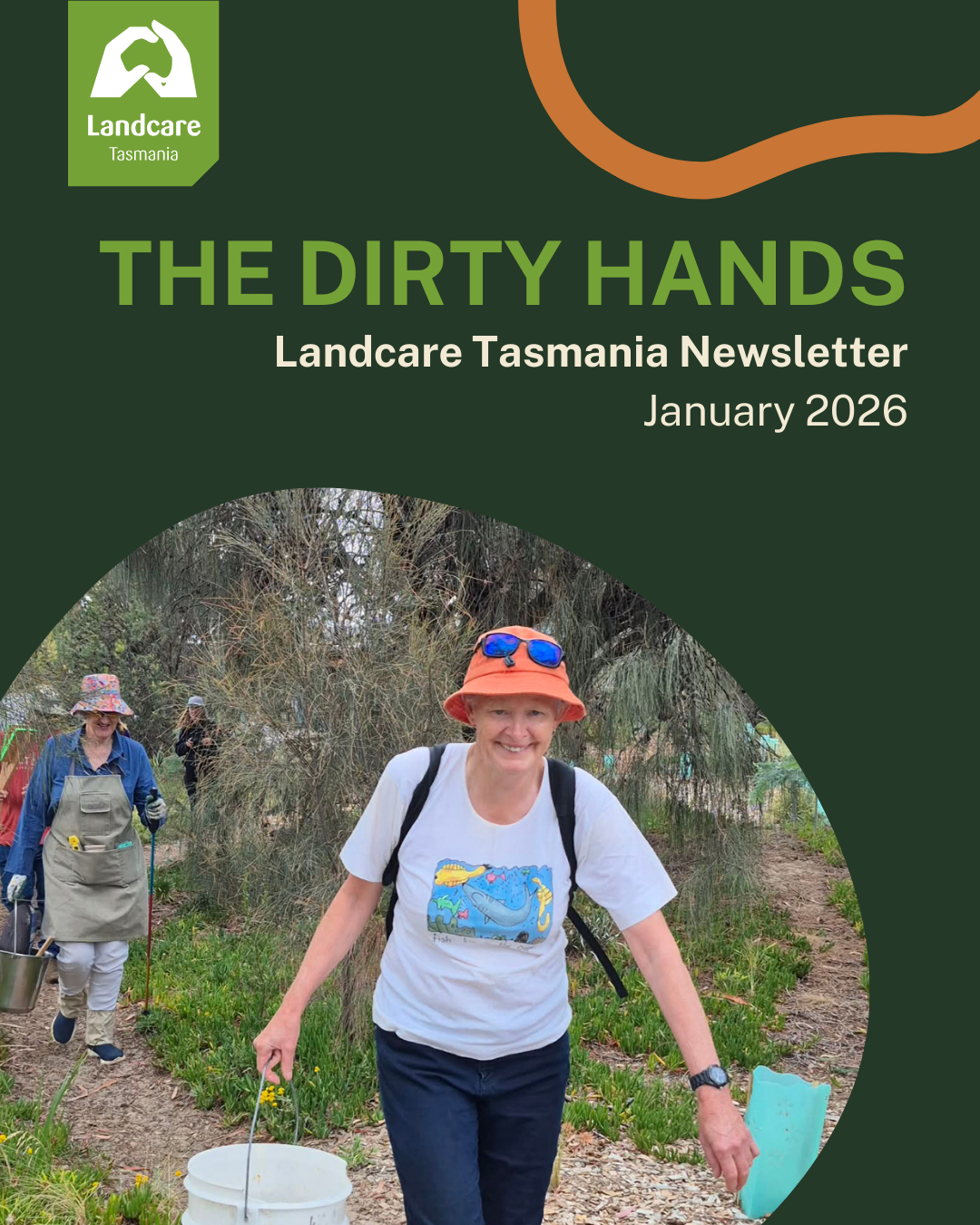
The Dirty Hands newsletter January 2026
Together in Landcare – Update from the CEO |
|
As 2026 kicks off, the momentum of the Community Landcare continues to grow. Across Lutruwita/Trouwerner, Landcare groups, volunteers, landholders, schools and community partners continue to show up — planting trees, restoring waterways, protecting habitat, learning together, and caring for the places we all depend on. Much of this work happens quietly, but its impact is felt for generations. This year brings both challenges and opportunities. Climate change, catchment health and biodiversity loss remain very real pressures on our landscapes and communities. But so too is the growing strength of people-led action, and the role local communities play in shaping positive change. Landcare works best when people come together. Individuals make a difference, but it’s community groups that hold the knowledge, relationships and long-term care for place. Alongside a big year of projects, programs and grants happening right across Tasmania, we’re putting extra focus on the behind-the-scenes support that helps Landcare groups thrive — the coordination, connections and practical support that keep local action going. Over the year ahead, you’ll see:
Whether you’re part of a long-standing Landcare group, a supporter or donor, a landholder restoring habitat, a student learning about ecosystems, or someone looking to get involved for the first time — there is a place for you in Landcare. Thank you for being part of this shared effort. We look forward to another year of learning, collaboration and action, grounded in community and care for our future. |
|
|

 |
|
Photo credit: Jayne Shapter, West Tamar Landcare group. How the Project Bank turns local ideas into actionLandcare Tasmania’s Project Bank helps turn grassroots ideas into on-ground outcomes across Lutruwita/Tasmania. It’s a central hub where Landcare members can submit project ideas (from weed management and habitat restoration to community education) and have them ready to match with funding, partners and support as opportunities arise. Since launching in 2019, the Project Bank has grown into a powerful tool for community-led action:
Importantly, projects stay in the Project Bank even if funding isn’t secured straight away, meaning good ideas aren’t lost. By seeing the full picture of member priorities, we can better advocate for funding and support where it’s needed most. The Project Bank is a practical example of how local knowledge and passion, backed by the right systems, can deliver lasting environmental benefits, one project at a time. Click below to read more on the West Tamar Landcare group's lasting impact through the Project Bank. Become a member to submit your project. |
|
The Ripple Effect Project |
 |
|
The Ripple Effect Project is now underway in Lutruwita/Tasmania - bringing innovative water management practices to our agricultural landscapes and helping farmers build resilience in the face of climate change. Funded with $5 million through the Australian Government’s Natural Heritage Trust Climate-Smart Agriculture program, this national initiative is focused on enhancing farm water security, biodiversity, carbon reduction and community connection. Led by the Grower Group Alliance and supported by universities and regional groups, the project is working with Natural Resource Management, Landcare and grower groups across the country to drive adoption of sustainable on-farm practices. Here in southern Tasmania, Landcare Tasmania has established two sites where farm dam improvements are being monitored to demonstrate the benefits of farm dam enhancement for reducing greenhouse gas emissions, increasing stock water quality and creating wildlife habitat. This initiative exemplifies how innovation and collaboration ripples out from local action to create broader environmental and social impact. Photo: Blue Carbon Lab Pondi being deployed at Logie Farm, Richmond. The Pondi is monitoring greenhouse gas emissions: methane, carbon dioxide and nitrous oxide. |
|
Plant grant program highlights 2024-25 |
 |
|
Landcare Tasmania supported 18 member-led projects this season through our plant grant program, helping put more than 4,000 native plants in the ground across the state! From revegetating riverbanks to strengthening habitat corridors and improving waterway health, these projects show the real impact community action can make. Across Tasmania, groups like Ellendale Landcare and Friends of Dempster Creek have been tackling weeds, stabilising riverbanks and restoring habitat for wildlife such as platypus, bandicoots and freshwater crayfish. The Plant grant program will open again in mid-2026. Photo: Friends of Dempster Creek |
|
Generations of Landcare at Glenora District School |
|
|

|
Update on the National African Boxthorn Biocontrol Project |
|
Landcare Tasmania is inviting farmers, First Nations communities, Landcare groups and community members to participate in training and on-ground action to reduce the spread of African Boxthorn in Tasmania. |
 |
|
The invasive African boxthorn (Lycium ferocissimum), a drought-tolerant Weed of National Significance. Photo courtesy of CSIRO. The African Boxthorn Biocontrol and Drought Resilience Project is a national initiative led by CSIRO and the Centre for Invasive Species (CISS), with funds from the Australian Government’s Future Drought Fund. The project aims to suppress the invasive African boxthorn (Lycium Landcare Tasmania will support the national delivery by connecting people to CSIRO for establishment and monitoring of release sites, deliver biocontrol training workshops, and an online webinar taking place on 26 February (see details in the Upcoming Workshops section, below). How do I get involved?If you have an infestation of boxthorn and would like to be part of this project, please fill out an Expression of Interest form on Landcare Tasmania's Projects page. Participants will receive Puccinia rapipes biocontrol kits with clear instructions for release and monitoring, supported by training materials, workshops, and field demonstrations provided by CSIRO. |
|
Upcoming workshops |
Biological control of weeds in Tasmania (Boxthorn and Sea Spurge) |
|
|


|
|
|

Take the Regional weed management survey!Community groups and individual members in the Cradle Coast region are invited to take part in a short survey to help update the Regional Weed Strategy for the Cradle Coast region. This new strategy will guide how weeds are managed across all our local municipalities over the next 10 years, with a review in five years to make sure it stays relevant. |
|
Other news & events |
New palawa kani app |
|
|

On Farm Forum: Future Proofing for Climate Resilience |
|
|

Pitt Water-Orielton Lagoon: Walk & Talk |
|
|

Protect Aussie birds from lethal rat poisons |
|
|

Join your local Landcare group!Want to get involved? Check out our directory of groups and upcoming working bees/events happening all over the state! Photo courtesy of the City of Hobart. |
 |
|
Interested in joining us? |
|
|
|
|
Thanks from the team at Landcare Tasmania We want to hear from you! (03) 6234 7117 Sign up for the Dirty Hands newsletter.
|


